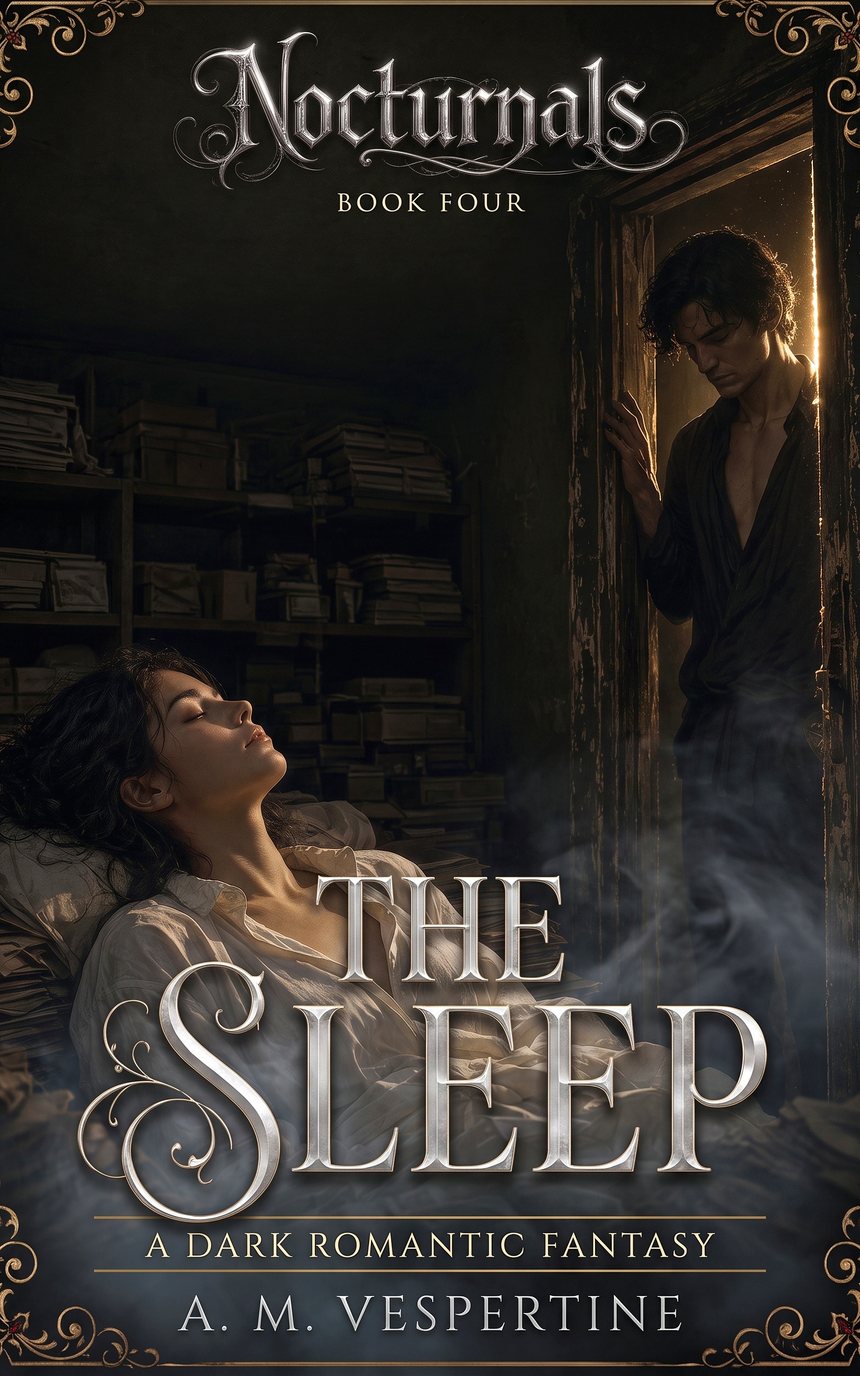
IV
The Sleep
A Dark Romantic Fantasy · Nocturnals, Book 4
Something has been standing in Elise Vess’s sleep since she was eleven. It has never been given a name that would hold.
- The couple
- Elise Vess and Vael
- Register
- Obsession, dream/waking edge
- Its instrument
- the Waking Hour
- Length
- 105,979 words · 341 pp
On the pageDark romance, heaviest of the series. Contains the series' most explicit sexual content, on the page; obsession and watcher themes; dream/reality consent as the book's subject; religious coercion; nightmare and body-horror imagery. All romantic leads are adults.
Read chapter one — provenance free · 1,788 words, no sign-up
The book
She is the best archivist in the treaty and she knows it. The Duskmantle estate index is missing one covenant. The gap is not a filing error. At the other end of it is Vael — Hollow, starving, fluent only in the place where her yes does not count.
The book is about the seam: what is asked for asleep, what is asked for awake, and what a creature becomes when the first word it can say in the morning is a contraction. She will not sign a document that uses her family as escrow. She will make him ask in the light.
The heaviest book in the series. A standalone dark romantic fantasy. Obsession. Dream / waking consent. Open-door explicit heat. Nocturnals, Book 4. Complete in itself. Best read after The Last Light. 18+.
Read the full description
Something has been standing in Elise Vess’s sleep since she was eleven. It has never been given a name that would hold.
She is the best archivist in the treaty and she knows it. Four years into the Duskmantle estate index at Vespertine, she finds a covenant that is not missing as a filing error. The gap has a shape. At the other end of it is Vael — Hollow, starving, fluent only in the place where her yes does not count. He has stood in the doorway of her sleep every night since she was a child, and he has been starving for it since she was old enough to know the difference.
Nothing dreamt can be used in argument, in reproach, or in kindness. That is the instrument she writes, because a dream and a Hollow are the same substance and there is no seam. Anything wanted must be asked for awake, at a table, in daylight. The appetite is established in a signed and dated deposition, read back and initialled. Then the asking is done on the page — descent, waking hour, the night before — in the published dark-romance register. She will not sign a document that uses her family as escrow. She will make him ask in the light.
The Vess line dreams true for a reason the treaty never filed. A mouth is not a stomach: Hollow are a passage, not a keeper, and nothing they take is ever theirs. What is taken rots. What is given stays. Elise is twenty-eight, four years into a catalogue, and she is about to find out that her nightmares were the work — and that the office her bloodline holds is not a privilege. It is a custody she never agreed to, split from the half that held the questions, for sixteen hundred years.
Vael has carried four sewn leaves and eleven characters he cannot read. She has the other half of the filing and no idea she is a filing. The Congregation of the Waiting has an opinion about both of them. The book does not ask you to find the monster sexy and stop there. It asks what a yes is worth if it was given in a room that was not a room, and then it makes him ask again in the morning, when she can leave.
If you want the lightest Nocturnals, this is not it. If you want the one that treats consent as a finding-aid and then tests the finding-aid until it cracks, and still refuses to let a dream count as a contract, start the series at The Tithe and arrive here on purpose. Elise catalogues. Vael waits in the doorway. The morning is the only jurisdiction that matters.
There is a hearing in this book. It is not a battle. It is evidence taken in closed questions, answered by weight, by a thing that behaves differently when it is being properly asked. Nobody is a cheap villain. The orthodoxy is right about nearly everything and objects in the correct form. Elise will survive four minutes of an undiluted arrival by cataloguing it. Then she will make the rest of the world use her procedure.
This is the heaviest book in the series, and it is marketed so. Obsession. Watcher. Dream and waking consent as the plot, not as a spice tag. Religious coercion. Body-horror. The peak is not a dream. The peak is a woman at a table at eleven in the morning saying what she wants, out loud, and then getting it in the dark she already knew.
A standalone dark romantic fantasy. Nocturnals, Book 4. Complete in itself. Best read after The Last Light. Open-door explicit heat. 18+.
On the page: the series’ most explicit sexual content; obsession and watcher themes; dream and waking consent as the plot; religious coercion; nightmare and body-horror. All romantic leads are adults.
Free to read · no sign-up
Chapter One — Provenance
- Length
- 1,788 words
- Of
- 35 chapters
- Volume
- Book 4 of 5
- Heat
- Explicit · 18+
This is the opening of Book 4. It stands on its own as a romance, but it is written after The Tithe, The Hunt, The Last Light and assumes their world. Start at Book One if you would rather nothing was given away.
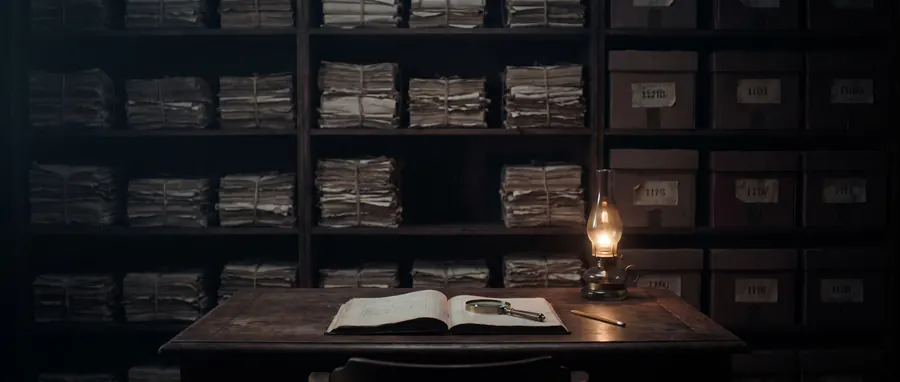
There are four hundred and eleven boxes in the muniment room at Vespertine and I have opened three hundred and nine of them, and the one I want is not there.
I want to begin with the method rather than the mystery, because everybody wants the mystery and the method is the only part I am actually good at.
Here is what an archivist does.
Provenance. Where did a document come from. Not who wrote it — who had it, and from whom, and by what right. A charter with a perfect text and no provenance is worth nothing at all; a laundry list with an unbroken chain of custody back three centuries will hang a duke.
Custody. Who has held it since. Every hand, every move, every shelf. A gap of twenty years in the custody of a document is not a gap in the record. It is a hole in the document, and everything that instrument says afterward is worth exactly as much as your account of those twenty years.
And the finding-aid, which is the thing nobody outside the trade has ever heard of and which is the whole of my profession: not a catalogue of what is there. A description of the shape of the collection — its arrangement, its logic, its lacunae — so that somebody in nine hundred years can tell the difference between a thing that was never here and a thing that has been taken out.
That is what I do. I have done it for ten years, four of them at the Hall of Records at Meridian and six here, and I am twenty-eight years old and I am the best in this treaty at it and I know that I am, and Mistress Ferrow told me at twenty-two that saying so out loud was the only thing standing between me and being paid properly.
The Duskmantle estate index is a beautiful thing and I have been in it for four years.
It runs from about DR minus four hundred and fifty, which is a great deal older than this house, because the family brought its papers with it from somewhere they will not talk about. It is arranged by instrument type and not by date, which is an old system and a bad one and which I have kept, because rearranging somebody's archive to suit yourself is the single worst thing a person in my trade can do and there are three hundred years of that in the Meridian records and I have spent my whole career undoing it.
Four hundred and eleven boxes. Three hundred and nine opened. Nineteen thousand items listed in my hand.
And in the index — the index, the original, in a scribe's hand of about DR minus three hundred and eighty — there are four references to an instrument that is not in any box.
The covenant, with the schedule of the seven.
Four references. Between DR minus three hundred and ninety-two and DR minus three hundred and eighty-eight. Cross-referenced from three different series, which is how I found it, because a thing referenced once is a mistake and a thing referenced four times from three directions was used.
And it is not there.
I did the withdrawal ledger first, because that is what you do.
Every archive keeps one. Every item out, who took it, when, when returned. This family's runs from DR minus four hundred and eleven to the present in nine volumes and it is the most complete series in the collection, because the Duskmantles have been keeping accounts since before they were Duskmantles and it is a family disease.
Four days. I read the whole of it — seven hundred and thirty-two years of a great house's withdrawals — and I did it the way Mistress Ferrow taught me, which is forwards, page by page, without skipping, because a person searching for one thing will find one thing and a person reading the whole series will find what is actually there.
There is no gap.
Not one. Seven hundred years, nine volumes, three different hands per century, and every single item that has ever left that room is entered and every one of them is entered back.
The covenant is not in it.
Which means it did not leave through the door. It was not borrowed and lost, it was not taken by a clerk and forgotten, it was not destroyed in the ordinary way with a note. Somebody removed a foundational instrument from this family's archive, at some point between DR minus three hundred and ninety-two and the present, without entering it — and the withdrawal ledger for that whole period is in the same hand as the index and is otherwise flawless.
I have written that finding four times in four years and every time it comes out shorter.
The document was not withdrawn. It was taken by somebody who knew what a withdrawal ledger was for.
Ivenne Duskmantle's answer came eleven days ago and it is four lines and I have it in front of me.
Mistress Vess.
A covenant without its schedule is unenforceable as to terms and perfectly enforceable as to existence.
Come to Solmere or I shall come to you; I have four years of arithmetic that belongs with your nine pages and neither of us can finish this alone. Do not travel before the spring; the Marrow road is bad.
You asked what a covenant is worth if the schedule is missing. It is worth exactly what the escrow says it is worth, and there is always an escrow, and nobody has looked for it.
— I.D.
I have read that fourth line about a thousand times.
There is always an escrow, and nobody has looked for it.
I did not know what an escrow was. I want that written down because everybody in this house has since assumed I did, and I did not; I am an archivist and not a lawyer and it took me a morning with Vespertine's own conveyancing series to find out.
An escrow is the third party.
When two parties make a bargain that neither can enforce against the other — when there is no court above them, no crown, nobody to appeal to — the thing they do, and have done for as long as anybody has written anything down, is put the stake with somebody else. A third party, chosen by both, who holds the instrument and the security and who has no interest of their own in the outcome.
The whole point of an escrow is that they cannot be leaned on.
And Ivenne Duskmantle, who has spent four years in a palace of mirrors doing sums about a stone tank, wrote to a twenty-eight-year-old archivist four hundred miles away to say: there is always one, and nobody has looked.
I am going to be honest about the dream now, because it is going to matter and because I have spent eleven weeks deciding how to write about it in a professional record and there is no way that does not sound like a madwoman.
So: the plain version, in the order I would put it in a finding-aid.
Description. A room. Long, low, whitewashed. Vessels in rows on racks — I have counted them nine times and it is between four hundred and four hundred and forty and I cannot get closer because the rows go back further than I can see.
Condition. Cold. Not cellar-cold. The other kind.
Arrangement. The racks are in nine ranks with a passage down the middle. There is a wall at the far end and I have never reached it. I have walked toward it eleven times.
Lacunae. I cannot see the ceiling. I have never once looked up in that room and I have tried, awake, to make myself remember looking up, and there is nothing there.
And the anomaly, which is the reason this is a professional problem and not a nervous one:
The vessels are the wrong shape.
I have been six years in a house with nine hundred and eleven gallons of the stuff in the cellar. I have been down there twice, properly, with Ivenne, with a lamp. I know what our vessels look like: four hundred and eleven of them, three hundred and seventy-two original wing-cans with wax collars and thirty-nine of ours, which are Vespertine cooperage and have a different shoulder.
The vessels in that room are neither.
They are taller. The collar sits differently. There is a mark on the shoulder that I have drawn eleven times, awake, from memory, and the eleven drawings agree with each other to a degree that frightens me rather more than the room does — because I am an archivist and I know exactly what it means when eleven independent recollections agree in a detail.
It means I am not remembering.
It means I am describing.
There is somebody in that room with me.
I have put it last because I did not want it in the same paragraph as the vessels, and because I have never written it down anywhere before, and because I have told exactly one person and she is four hundred miles away and I told her in a postscript.
They have never frightened me.
Seventeen years. That is not an exaggeration and I have the dates; I built the chain of custody for my own sleep the way I would build one for a chartulary, and it holds: something began standing between me and my nightmares in the autumn of DR 304, when I was eleven, and did it for eight years without one interruption, and stopped in the spring of 312, and started again in a different way in 316.
And last week they said something.
Not in a dream. That is the whole of the difficulty and it is why I have finally written it down.
I was awake. I was sitting up in bed in the west range with the lamp out at about the fourth hour and I had come out of the room with the vessels in it, and I was frightened, and something in that room with me — in the actual room, in Vespertine, with the door shut and the bar across it —
said: "You were dreaming. You are not now."
And I sat up in the dark and said thank you, out loud, like an idiot.
Because my sister told me to, at a coach, at first bell, nine years ago, with her collar crooked and her whole life in a bag.
If you meet the kind thing first, thank it.
What you get
Three editions of the same book.
The paperback is a 6 × 9 in perfect-bound trade edition of 341 pages. The ebook is the EPUB itself, without DRM, for any reader you own. The audiobook is 10:38:31 across 37 MP3 files, narrated by a digital voice and kept rather than streamed. Buy all 5 volumes in paperback and every ebook and audiobook comes with them.
dream lover dark romance · obsessed watcher romantasy · archival heroine spice · sleep paralysis romance · consent as the plot · gothic monster romance · explicit dark romantasy
| Words | 105,979 |
|---|---|
| Pages | 341 |
| Trim | 6 × 9 in |
| Runtime | 10:38:31 |
| Tracks | 37 |
| Set in | DR 321 |
| ISBN, EPUB | 979-8-90623-937-2 |
| ISBN, MP3 | 979-8-90623-938-9 |
| ISBN, paperback | not yet registered |
Page count measured from the print file; runtime measured from the audio masters on 2026-08-29.